English
 Deutsch
 Espanol
 Français
 Portuguese
 中文
中文 한국어
한국어 日本語
日本語
Amazon AppStream 2.0
What is Amazon Appstream 2.0?
Amazon AppStream 2.0 allows organizations to publish individual applications that are then streamed to end users on any device using an HTML5 browser, providing those applications as SaaS (Software as a Service).
AppStream 2.0 is well-suited as cloud alternative to many on-premises use cases that implemented Citrix XenApp (CVAD) or apps hosted via Microsoft RDS, as well as CAD-in-a browser like options.
The advantages of AppStream 2.0 include:
- Ability to support access from a wide range of devices including tablets, thin clients, and workstations, including BYOD (bring your own device).
- Eases the maintenance and lifecycle management of applications, a single centrally managed and definitive version of each application can be patched and managed.
- Many organizations have bespoke and legacy applications that require custom configurations (specific hardware, certain driver versions, and so on) and simply do not work when published to vanilla VDI (Virtual Desktop Infrastructure) or DaaS (Desktop as a Service) desktops or local machines. Moreover, when organizations have multiple custom or legacy apps, the customizations may conflict. Publishing such an application via AppStream 2.0 as SaaS resolves such considerations.
- Applications can be accessed on a wide range of OSs including Windows PC, Linux PC, Chromebooks, and Macs.
Who uses Amazon Appstream 2.0?
For ISVs (Independent Software Vendors) developing applications, AppStream 2.0 offers a platform they can use as a business model to supply their application titles as SaaS directly to customers. There is a good range of information for software vendors available on Amazon’s website (see Amazon AppStream 2.0 | Software Vendors).
Benefits, beyond the above use cases, that appeal to software vendors include:
- The ease with which they can offer free trials.
- The ability to leverage Amazon’s vast, yet regionalized datacenters and infrastructure to expand to new customers and trial new markets.
- The wide end-point OS support can remove the need to port applications to various OSs reducing costs and accelerating time to market.
Indeed, many ISVs have already adopted AppStream 2.0, including heavyweight 3D and CAD/AEC application vendors such as Siemens, Dassault, and Autodesk.
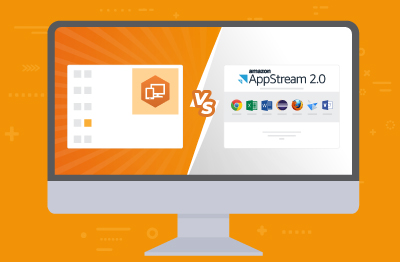
Amazon AppStream 2.0 vs Amazon WorkSpaces
Amazon offers two different services, Amazon WorkSpaces and AppStream 2.0, that can be used to deliver apps remotely either streamed via a browser or within a virtual workspace (desktop). Once you understand the differences between the two services the choice is usually clear from the use case. It is in fact common for organizations to use a mixture of both.
For a detailed comparison of both technologies, see the blog article Amazon AppStream 2.0 vs Amazon WorkSpaces.
Amazon AppStream 2.0 Monitoring and Virtual Desktop Monitoring
As with any digital workspace technology, performance monitoring of virtual desktops deployed on the cloud is important. Performance metrics can be collected in different ways:
- Synthetic monitoring using software robots that check if the virtual desktop service is available and responsive.
- Integration with AWS CloudWatch to collect utilization metrics for Amazon WorkSpaces and AppStream 2.0.
- Insights into the virtual desktops obtained using light-weight agents deployed within the desktops. Often these agents are built into the images used to spin up the virtual desktops dynamically.
An effective monitoring solution should provide visibility into application availability, session responsiveness, resource utilization, user experience, and infrastructure dependencies. For organizations running both AppStream 2.0 and Amazon WorkSpaces, unified monitoring can help correlate application and virtual desktop performance from a single console.
eG Enterprise provides capabilities for monitoring both Amazon WorkSpaces and AppStream from one console. Learn more about Amazon AppStream 2.0 monitoring with eG Enterprise.
How Does Amazon AppStream 2.0 Pricing Work?
Amazon AppStream 2.0 pricing depends on factors such as the instance type, usage duration, and resources provisioned for application streaming. Organizations evaluating AppStream 2.0 should consider both infrastructure consumption and the number of users or applications being delivered when estimating overall costs.
Frequently Asked Questions (FAQs)
Amazon AppStream 2.0 is a fully managed AWS application streaming service that lets organizations securely deliver desktop applications to users on any device without rewriting software. It streams applications from AWS infrastructure, enabling remote access, centralized management, automatic scaling, and enhanced security while reducing infrastructure administration.
Amazon AppStream 2.0 pricing is based on the resources you use, including streaming instances, fleet type, usage duration, storage, and user access. Organizations pay for provisioned compute capacity and related services, with no upfront commitments, allowing costs to scale according to application demand and usage patterns.
Amazon AppStream 2.0 is designed for streaming individual desktop applications, while Amazon WorkSpaces provides full virtual desktop environments. AppStream 2.0 is ideal when users need access to specific applications, whereas WorkSpaces is better suited for users requiring a complete desktop experience with persistent workspace access.
Amazon AppStream 2.0 can be monitored using eG Enterprise, which provides visibility into fleet utilization, user sessions, application performance, resource usage, and overall system health. IT teams can use dashboards, historical reports, trend analysis, and proactive alerts to identify issues, optimize resource allocation, troubleshoot user experience problems, and maintain reliable application delivery.